LoveMeow.com for ultimate cat lovers
Photobucket

Showing posts with label cat health. Show all posts

Friday, August 19, 2011

Diabetes Cat


Before this I dunno cat also have problem with diabetes. Just share info from internet

New Hope for Diabetic Cats

The future of feline diabetes looks promising. As research into the development of new prescription diets, new types of insulin, home monitoring devices, oral medications and ideal feeding schedules moves forward, management of this frustrating disease should become less of a headache for veterinarians and cat owners.

Diabetes in Cats
Feline diabetes is a common glandular disorder estimated to affect 1 in 300 cats. Diabetes occurs from a decrease in insulin secretion from the pancreas and/or a decrease in the action of insulin, which is a hormone required for metabolizing carbohydrates.

There are basically two types of diabetes. Type 1 diabetes is comparable to insulin-dependent diabetes in humans; the body does not produce adequate amounts of insulin, and treatment requires insulin injections. Type 2 diabetes resembles non-insulin-dependent diabetes in humans; the body may secrete insulin but does it abnormally, and the tissues may not recognize the insulin. Cats with type 2 diabetes can sometimes be managed with oral medication and dietary therapy, but as the disorder progresses, insulin deficiency occurs, and insulin injections are ultimately required.

Currently, there is no reliable way to determine whether a cat is a type 1 or type 2 diabetic. Some experts think that type 2 diabetes is more common in cats than type 1, but the true incidence remains unknown.

Necessary Action
Though all cats are at risk for diabetes, middle-aged and older males are more susceptible. Purebred cats tend to be at decreased risk for diabetes, except for the Burmese, which is four times more likely to be stricken with diabetes.

The classic clinical signs of diabetes include excessive thirst and urination, extremely good appetite and weight loss. Some cats also exhibit neurological dysfunction in their rear legs.

Diagnosing feline diabetes is usually straightforward. High blood sugar accompanied by sugar in the urine confirms the diagnosis. Some cats are very stressed while at the veterinarian's office, which can result in high blood sugar or hyperglycemia. However, these stressed cats rarely have sugar in their urine. In cases where a cat has high blood sugar and a trace amount of sugar in the urine, a blood test called fructosamine is available that allows veterinarians to differentiate stress-induced hyperglycemia from diabetes.

Dietary issues have played an important role in the management of feline diabetes. For years, high-fiber diets were recommended in the initial management of diabetes. More recently, research has shown that for cats, as pure carnivores, diets low in carbohydrates and high in protein are more appropriate. According to research, the use of such diets can lower the insulin requirements of most diabetic cats.

In some cases, the diabetes can be managed using diet alone. It is impossible to predict which cats will respond to a high-protein diet and to what degree the insulin dose can be reduced. Diabetic cats transitioning to these new diets need close monitoring during the first few months to ensure that hypoglycemia (low blood sugar) doesn't occur. Cats with kidney disease also must be watched closely, as high-protein diets can increase the progression of kidney failure.

Cats with diabetes have been encouraged to eat several small meals throughout the day, to minimize fluctuations in blood sugar. However, a recent study suggests that although cats naturally like to nibble on food 10 to 20 times a day, those nibblers experience higher insulin concentrations than those that get fed once daily. Therefore, letting diabetic cats nibble throughout the day may increase the demand on their already-impaired pancreas to secrete insulin - contributing to pancreatic cell burnout. Cats predisposed to poor glucose tolerance or diabetes may do better if fed once daily. Further studies are necessary to determine the optimal feeding strategy for diabetic cats.

A Dose of Hope
Most diabetic cats require insulin injections to control their diabetes. Years ago, most veterinarians administered a type of insulin called protamine zinc insulin (PZI), which is derived mainly from cattle. Cats respond well to bovine insulin, because the molecular structure of feline insulin closely resembles bovine insulin.
However, when genetically engineered human insulin became available, veterinarians began using it to treat diabetic cats. Of the many forms of human-derived insulin, lente and ultralente insulin are the most commonly prescribed. Fortunately, cats respond well to these insulin types, although most cats require twice-daily injections.

Recently, a new synthetic analogue, glargine insulin, was approved for the treatment of diabetes in humans. Veterinarians wondered if this insulin would also be effective in cats, especially if given only once daily. A recent study revealed the once-daily administration of glargine insulin to cats provided a significant blood glucose lowering effect, but was not as effective as twice-daily administration. Glargine does appear to provide superior control of the diabetes compared to lente and ultralente insulin.

Although most diabetic cats ultimately require insulin injections to control their diabetes, some cats with type 2 diabetes can rely on oral medications. Several oral medications are available to treat diabetes, but there is scant published data on the effectiveness of these drugs in cats. On the basis of limited data, glipizide and acarbose appear to be the most effective and have the least potential for toxicity in cats, when compared to troglitazone and metformin.

Studies are underway to determine which oral agents, either alone or combined with insulin, best control feline diabetes.

Determining blood-sugar concentrations and serial blood-glucose curves are important aspects of long-term management in diabetic cats. Humans with diabetes monitor their own blood sugar at home with portable blood glucose monitors. Cats, however, go to the veterinary hospital for blood-glucose monitoring.

Recently, however, a technique was described in which owners learned to obtain blood from their cats ears and measure the blood-glucose levels in their homes, using a portable glucose meter. The owners of seven healthy cats performed two glucose curves, measuring blood-glucose concentrations every two hours for a total of 12 hours. Three of the seven owners were able to perform a reliable glucose curve. The studys authors concluded that home monitoring of blood-glucose concentrations may serve as a new tool in the management of diabetic cats.

Article From :- Catchannel.com


The article is too long.. But there's many tips for us about diabetic cat.. I must look up for Oyen.. He's getting bigger now..

Saturday, June 11, 2011

Cat Eye's disease

One of most common disease that effect on cats is eye's disease. It also infect cats in my house. Lak is the newest cat infect on the disease. His eye's turn red ( I'm not taking the eye pic because it will give side effect).
We tried to clean it almost everyday and it show positive effect even 'Lak' don't want and always scream..


Today entry I just want to share some info about cat eye's disease that I've gathered via internet..


Common Symptoms of Illness

 red inner eyelids (this occur to Lak's eye)
matter ‘stuck’ on the surface or in the corners of the eye (it is also occur to Lak's eye)
cloudiness within the eyeball
a dull eye surface
the ‘third eyelid’ coming across the eye
excessive tearing or unusual discharges (it occur to Longot ..)

tear-stained fur around the eyes


Eye Tests used to Diagnose Eye Problems


Fluorescein stain to identify the presence of corneal ulcers
Schirmer Tear Test to determine the level of tear production
Ocular pressure to detect glaucoma
Ophthalmoscope to see in the eye chamber

Common Eye Conditions & Symptoms

Conjunctivitis is an inflammation of the membrane that covers both the inner lining of the eyelid and the white of the eye. It may be caused by allergies or by bacterial, fungal or viral infections. In fact, recurrent or chronic conjunctivitis in cats is often the result of herpes viral infections which, just as in humans, can return - again and again. It can be contagious between cats, so keep an infected cat away from other cats. Terramycin Ophthalmic Ointment is an OTC eye medication that veterinarians often dispense for upper respiratory problems in cats.
Corneal Ulceration can occur when the surface of the cornea is scratched or damaged, either as the result of a cat fight or more seriously, a bacterial or viral infection.

Watery Eyes
If your cat’s eyes constantly “weep”, or if the fur around them appears “stained”, he may suffer from this inherited defect, in which a malformation of the tear ducts blocks the normal flow of tears.

Cataracts & Glaucoma
Cats, just like humans, can have these serious eye diseases. Cataracts, which cloud the lens inside the eye, are most often seen in elderly or diabetic cats. A thorough evaluation by your veterinarian is necessary, as surgery is the only treatment. Glaucoma stems from too much pressure being exerted upon the eye's interior as a result of a decrease in the amount of fluid draining from it.
The OcluVet “Ocular Restoration System”
OcluVet (Click for price/product information) is an advanced nutriceutical formulation developed to address the contributing factors of lens opacities like cataracts and helps restore clearer vision.


How to Administer Eye Drops
1. Remove any discharge around the eye with a cotton ball moistened with saline solution.
2. Hold your cat sideways on your lap or place him on a table at a comfortable height (you may want someone to help restrain your cat if you choose the second option).
3. See the instructions on the bottle for dosage. Shake if necessary.
4. Use one hand to hold the bottle between thumb and index while using the other to support the cat’s head.
5. Tilt the head back and, to prevent blinking, use your free fingers to hold the eyelids open.
6. Hold the bottle of drops close to the eye but DON’T touch the eye’s surface.
7. Squeeze, aiming the drops at the centre of the eye, then release the head after the drops are in the eye.
8. Your cat will blink, spreading the medication over the eye’s surface.

How to Apply Eye Ointment


1. Remove any discharge around the eye with a cotton ball moistened with saline solution.
2. Hold your cat sideways on your lap or place him on a table at a comfortable height (you may want someone to help restrain your cat if you choose the second option).
3. Check the instructions on the tube for dosage.
4. Gently pull back upper and lower eyelids.
5. Hold the tube parallel to the lower eyelid, squeeze out the ointment onto the edge of the eyelid (about the size of a grain of rice).
6. Release the head and let your cat blink.
7. If necessary massage upper and lower eyelids together to spread the medication.
Important: always administer medicine to its full term for it to be effective. When administering medication stay calm - your pet can sense if you are nervous, making it more difficult to apply the treatment. Always praise and reward your pet with a treat

Source :- Medi-Vet.com

It is such good information about cat's eye disease. Do you have any other information? Let's share..

Saturday, September 11, 2010

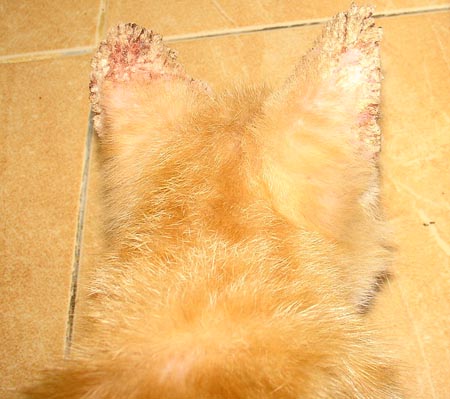
Oyen got ringworm

My cats ringworm infection in his ear. It is a bit ticklish when viewing the ears. Do not know what to do with the situation. Maybe next week will bring animals to the clinic Oyen.Poor this little cat.

Found some good info how to treat ringworm.


Ringworm treatment

Ringworm treatments include:

* Shampoos
* Lime sulfur dips
* Topical medications
* Trimming or shaving the fur (though some vets do not recommend shaving cats when treating ringworm, as it may actually spread the fungus)

1. Oral Medication:

Griseofulvin is the drug of choice for ringworm infections.

• It should be fed with a fatty meal or some corn oil to increase its absorption.

• Griseofulvin should never be given to pregnant animals and cats that are FIV-positive.

• Common side effects can include lethargy, loss of appetite, vomiting, and diarrhoea

Itraconazole is another drug that is increasingly used for ringworm infection.

• The efficacy of the drug is similar to griseofulvin, but it can be prohibitively expensive

• Should not be given to pregnant animals

• The most common side effect is nausea

Ketoconazole is a similar drug to itraconazole.

• Ketoconazole is infrequently used due to a high incidence of adverse side-effects and the resistance of some strains of ringworm to it.

2. Environmental treatment: Spores can survive for years in the environment. In order to minimise the spread of infection to other animals and people, it is imperative to effectively treat the environment. If possible, brushes, combs, and bedding should all be discarded.

Dilute bleach is an effective disinfectant for surfaces around the house. Vacuum-cleaning should be performed daily and disinfection weekly until the infection is eliminated.

3. Topical therapy: the jury is out about the efficacy of topical therapy. Traditionally, infected animals have been clipped and treated with topical antifungal preparations. Some effective treatments are enilconazole, lime-sulfur dips, and miconazole/chlorhexidine shampoo (Malaseb).


Source :- Suite 101
The Pawblog

There are a lot of useful information on the Internet. It should be taken to the vet and have to do as above tips.

Thursday, May 6, 2010

Tired of study

Look at this cat. She sleep at the file and paper.. Maybe tired after study for exam.. He hehe.. Just joke.. This cat sleep at my file.. Naughty, isn't she?

Tuesday, May 4, 2010

Black white cat

This is a picture of our cats. Also die because cat disease. Dunno what disease..


There are website explain about cat disease. This is the common of cat disease:-


Campylobacter Infection : A bacterial disease associated with cats, dogs, and farm animals.Cat Scratch Disease: A bacterial disease associated with cat scratches and bites.

Chronic Renal Failure, or kidney disease in cats, is a very common condition in cats. progressive and permanent damage to the kidneys that reduces their capacity to filter and remove waste from the blood.

Coxiella burnetti Infection : A bacterial disease occasionally associated with cats.

Cryptosporidium Infection: A parasitic disease associated with cats, dogs, and farm animals.

Dipylidium Infection (tapeworm): A parasitic disease associated with cats, dogs and fleas.

Hookworm Infection: A parasitic disease associated with cats, dogs and their environment.

Leptospira Infection (leptospirosis): A bacterial disease associated wild and domestic animals including cats.

Plague Infection: A rare bacterial disease associated with rodents and cats and fleas.

Q Fever : A bacterial disease occasionally associated with cats.

Rabies: A viral disease associated with various animals, including cats.

Ringworm: A fungal disease associated various animals, including with cats.

Roundworm: See Toxocara Infection.
Salmonella Infection : A bacterial disease associated with various animals, including cats.

Tapeworm : See Dipylidium Infection.

Toxocara Infection ( roundworm): A parasitic disease associated with cats, dogs and their environment.

Toxoplasma Infection : A parasitic disease associated with cats and their environment
Reference :- Acecathealth

Wow.. Many disease..

© Journey of Cat in My House - Template by Blogger Sablonlari - Provided by Free Blogger Templates